
Oklahoma Civil Court Records
Oklahoma civil court records are public documents held at each county's District Court. You can search them for free on the Oklahoma State Courts Network or visit a courthouse in person. The state has 77 counties, and each one keeps its own civil case files. These records cover contract disputes, property claims, small claims, family law cases, and more. The OSCN docket search portal lets you look up party names, case types, filing dates, and hearing schedules from any county. For certified copies of a judgment or other court documents, you need to reach out to the Court Clerk in the county where the case was filed. They can pull files by name or case number and make copies on the spot.
Oklahoma Civil Court Records Overview
Where to Find Oklahoma Civil Court Records
Civil court records in Oklahoma are kept at two levels. The District Court in each county is the main source. Every county has a Court Clerk who manages the case files. That office holds petitions, motions, orders, judgments, and all other papers filed in a civil case. If you know the county where the case was filed, start there.
Oklahoma also runs two free online systems that cover civil court records statewide. The Oklahoma State Courts Network is the official portal run by the Oklahoma Supreme Court. It has docket info for all 77 counties. You can search by name, case number, or date. The system shows party names, case types, filing dates, and hearing schedules. Most courts update within 24 hours. Some document images are also viewable as PDFs. The second option is On Demand Court Records, which covers many of the same counties but may have records that OSCN does not, and the other way around too. For a full picture, check both. Basic searches on ODCR are free. Document images need a paid plan.
Land records sit with the County Clerk, not the Court Clerk. These are deeds, mortgages, liens, and other instruments tied to real property. The site OKCountyRecords.com gives free access to land records from 66 of the 77 counties, with over 27.5 million records and 93 million scanned images. Revenue from that site goes right back to each county.
Note: Court records and land records are kept by different offices. The Court Clerk handles civil case files and judgments. The County Clerk handles deeds, mortgages, and property filings.
How to Search Civil Court Records in Oklahoma
The fastest way to search Oklahoma civil court records is through OSCN. Go to the site and pick a county from the drop-down list. You can search by case number if you have one. Civil cases use the CJ format for claims over $10,000, CS for claims under $10,000, and SC for small claims. If you do not have a case number, use the party name search. Type in the last name and pick the county. You can add date filters to cut down the results.
The OSCN search page supports several search fields. Case number search is the fastest and most exact. Party name search lets you find cases when you only know a name. You can filter by party type, case type, and date range. The system also has a traffic citation search and a lower court case number search for tracking appeals. Wildcard searches work too. For example, "Smith, J" pulls up Smith, John and Smith, Jane and Smith, James.
The OSCN portal shows what it calls docket entries. Each entry is a line on the case timeline.
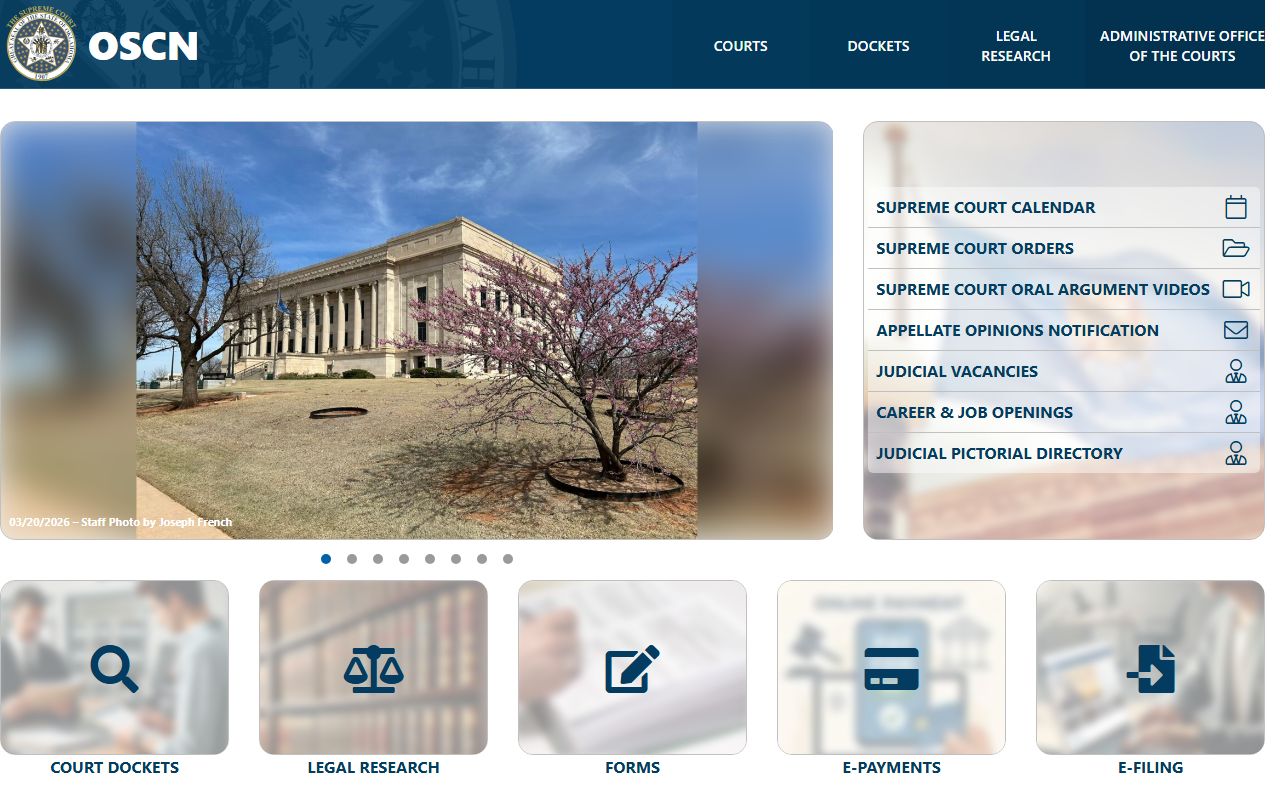
The screenshot above shows the OSCN search interface. From this page you can start a search for civil court records in any Oklahoma county. The system is free and no login is needed.
On Demand Court Records works in a similar way. Visit ODCR and pick a court from the list. The free plan gives you basic searches and full docket info. The $5 a month plan adds date of birth filters, geographic filters, and case monitoring. If you need actual document images, that costs $55 a month and is limited to bar members. For most people doing a basic civil court records search, the free options on both OSCN and ODCR are enough.
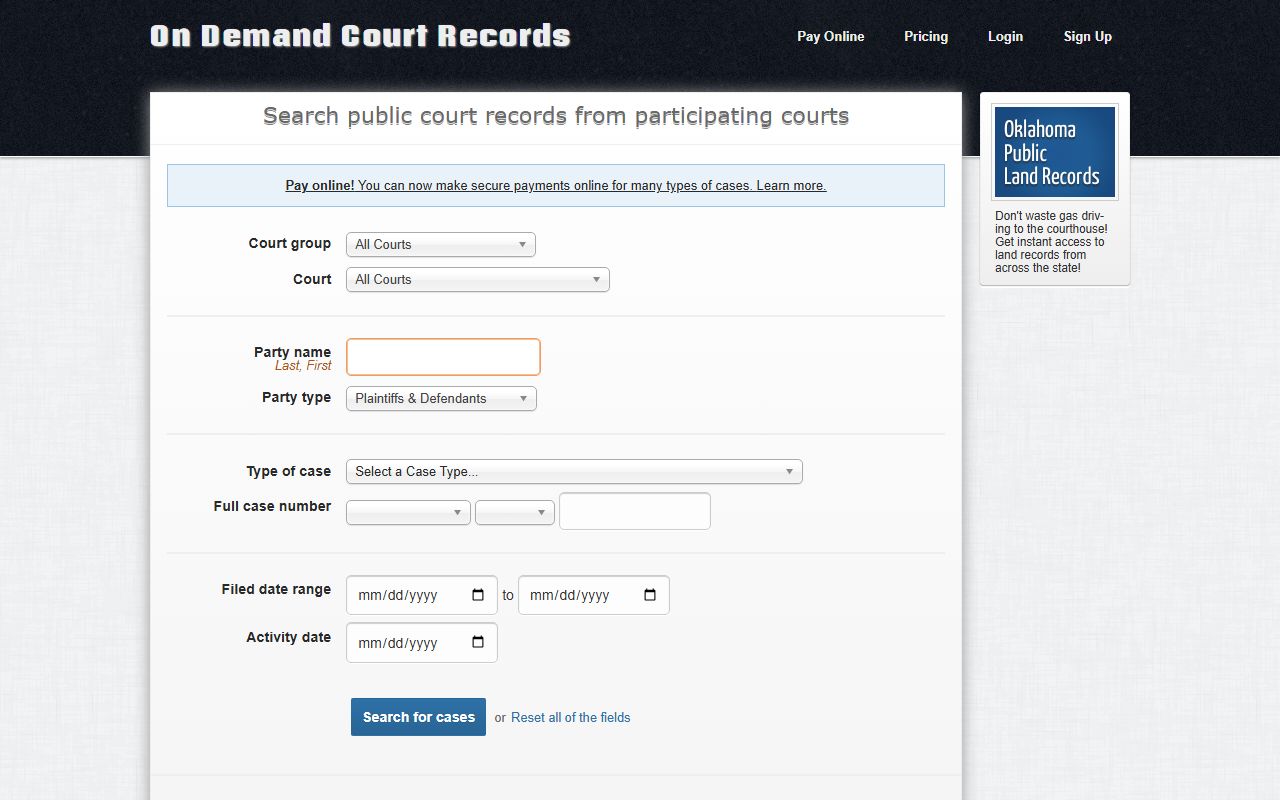
ODCR provides another way to look up Oklahoma civil court records. It covers over 70 counties and includes some tribal court records that OSCN does not have.
Types of Civil Court Records in Oklahoma
Oklahoma District Courts handle several types of civil cases. Each type gets its own case prefix so you can tell what kind of case it is just from the number. General civil cases use CJ and cover claims over $10,000. These include contract disputes, property fights, personal injury suits, and commercial cases. Small claims use SC and handle disputes up to $10,000 with simpler rules. Family court uses FD for divorce, custody, paternity, and protective orders. Probate cases use PB for estates, wills, guardianships, and conservatorships.
Under Title 12 of the Oklahoma Statutes, district clerks must keep an appearance docket, trial docket, journal, and other records the court may order. Section 12-23 says the appearance docket must show all actions brought, the date of summons, the return, the time of filing, all later pleadings, and an abstract of all judgments and orders. These rules set the floor for what every county must track.
A typical Oklahoma civil court record shows:
- Case number with year and county code
- Names and addresses of all parties
- Filing date and case type
- Docket entries in order of date
- Judgment amount and final disposition
Most civil court records in Oklahoma are open to the public. You do not need to be a party to the case. You do not have to give a reason for your request. Some items are restricted by law. Juvenile records are sealed. Adoption files are confidential. Mental health cases have limits. Cases sealed by a judge's order stay hidden from public view. Sensitive data like Social Security numbers and bank account numbers get blacked out before copies are given out.
Oklahoma Civil Court Records Fees
Fee rules for civil court records in Oklahoma come from Title 28, Section 31 of the Oklahoma Statutes. These fees are set by state law and apply the same way in all 77 counties. Searching on OSCN is free. Getting copies from the Court Clerk costs money.
The standard schedule is simple. The first page of any copy costs $1.00. Each page after that costs $0.50. If you need the copy certified, add $0.50 per document. Authentication runs $5.00. Bond approval with a seal is $3.00. These are the base rates. Some counties may charge a search fee of $5.00 to $10.00 if you do not have a case number and staff has to dig through records for you.
Civil case filing fees are separate from copy fees. A general civil case (CJ, claims over $10,000) costs about $232 to file, plus a $10 preservation fee. A small claims case runs around $219. These numbers include fees that get split among various state funds. Service of process by the sheriff adds more.
The Oklahoma Open Records Act under Title 51, Section 24A.5 caps standard copy fees at $0.25 per page for most government records. But a 2009 Attorney General opinion held that court clerk fees are set by their own statute and are not subject to that cap. So court copies cost $1.00 for the first page, not $0.25.
Note: Copy fees can add up fast for large case files. Call the Court Clerk first to ask how many pages a document has so you know what to expect.
How to Get Copies of Oklahoma Civil Court Records
There are three ways to get copies of civil court records in Oklahoma. You can go in person, send a mail request, or use email where the county allows it.
For in-person requests, visit the Court Clerk at the county courthouse. Bring a valid photo ID. Give the clerk the case number or the names of the parties. Tell them which documents you need and whether you want certified copies. Pay the fees in cash, check, or money order. Most counties also take credit cards now, but call ahead to be sure. Current records are usually ready right away. Older files stored off-site may take a day or two to pull.
Mail requests go to the Court Clerk at the county courthouse address. Write a letter with the case details, the documents you want, and your contact info. Include a self-addressed stamped envelope. Send a check or money order for the estimated fees. Most counties process mail requests in one to two weeks. If you are not sure about the fees, the clerk will call you before sending anything out.
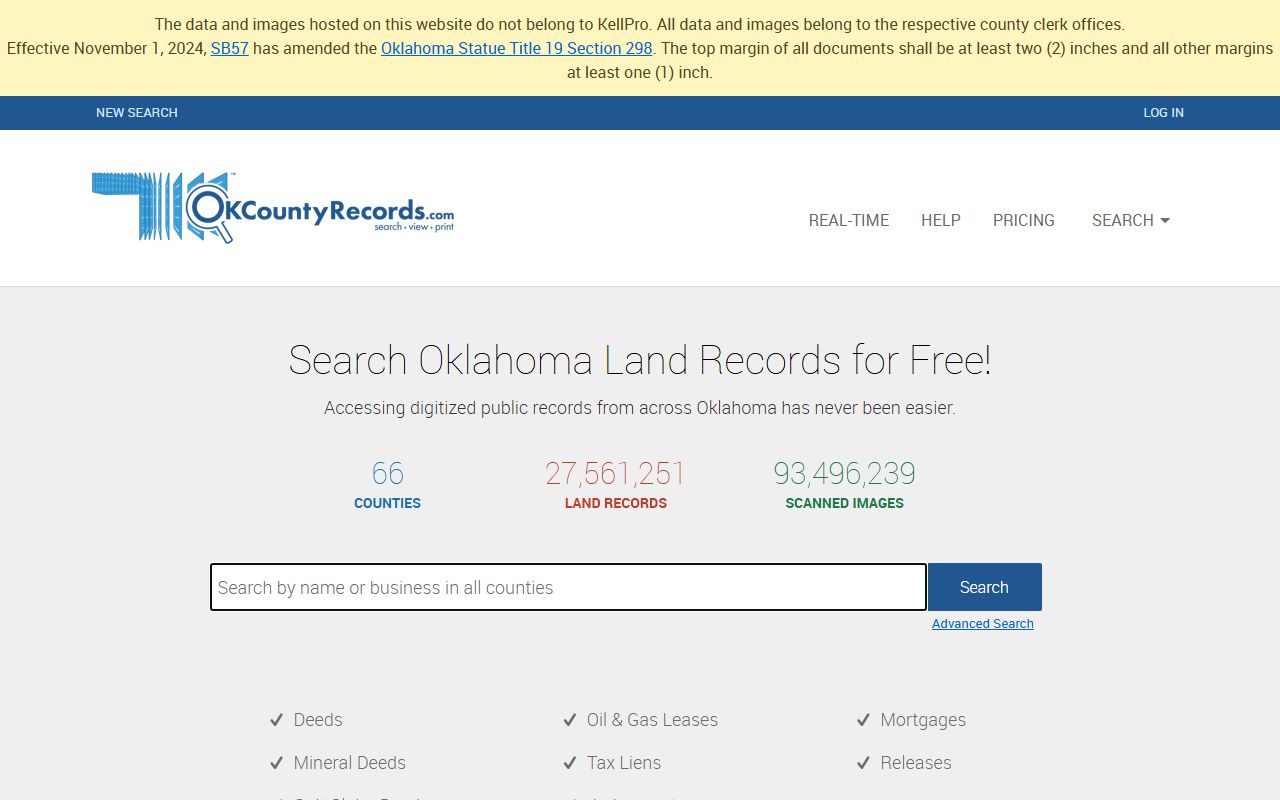
OK County Records provides free access to land records from 66 Oklahoma counties. While separate from civil court records, land records can be useful when researching property disputes and foreclosure cases.
Oklahoma Civil Court Records and the Law
The right to see civil court records in Oklahoma comes from two main sources. Title 51 of the Oklahoma Statutes contains the Open Records Act. Section 24A.2 says all records of public bodies shall be open to any person for inspection, copying, and reproduction during regular business hours. This is broad. It covers court records along with most other government files.
Title 12 adds rules specific to courts. Section 12-22 lists what records district clerks must keep. Section 12-24 allows records to be stored on microfilm, optical disks, or other media. That statute also says old paper records can be destroyed once two copies exist on another medium, with one copy going to the Oklahoma Department of Libraries Archives Division. Section 12-32.1A gives the Oklahoma Supreme Court power to set rules for how court records show up online, keeping the format the same across all counties.
There are limits. Section 24A.30 of the Open Records Act says court records that are sealed or made confidential by court order stay closed. Section 12-39 blocks certain charges from being posted on court websites. Records protected by attorney-client privilege, work product rules, or informer privileges are also off limits. Anyone who gets turned down for a records request can file suit under Section 24A.17, and if they win, the court may award attorney fees.
Legal Help for Civil Court Records
Legal Aid Services of Oklahoma helps low-income residents with civil legal matters, including help understanding court records and filing requests. You can reach them at (405) 557-0020. They also run a statewide hotline at 1-888-534-5243 for legal information and referrals.
Legal Aid serves people with incomes at or below 125% of the federal poverty line. They give priority to cases that involve domestic violence, elder abuse, and basic needs.
The Oklahoma Bar Association runs a lawyer referral service at (405) 416-7000. They can connect you with an attorney who handles civil cases in your area. The Oklahoma Pardon and Parole Board handles matters tied to record sealing and expungement. If a criminal case has been expunged, related civil records may also be sealed from public view.
The Oklahoma Department of Libraries maintains historical court records that have been microfilmed or transferred from county courthouses. Researchers looking for older civil court records not found on OSCN may find them through the state archives.
Are Civil Court Records Public in Oklahoma
Yes. Court records in Oklahoma are generally public under the Open Records Act and Rules of Public Access to Records of the Judicial Branch. You do not have to be one of the parties. You do not need a reason. Most of the case file is open to anyone who asks at the District Court.
Some parts of civil files have restricted access. Records involving minors may be sealed. Social Security numbers and bank account numbers get redacted. A party can ask the court to seal records if they have a strong reason, but this is not common. The judge weighs privacy concerns against the public interest before making that call. For sensitive personal data, the Supreme Court has rules under Rule 3 that require clerks to black out certain identifiers before handing over copies.
The Pardon and Parole Board works with the Administrative Office of Courts and OSBI to process record sealing requests. When criminal records get expunged, any related civil records from the same incident may also be removed from public search portals like OSCN and ODCR.
Browse Oklahoma Civil Court Records by County
Each of Oklahoma's 77 counties has its own District Court that handles civil cases. Pick a county below to find local contact info and resources for civil court records in that area.
Civil Court Records in Major Oklahoma Cities
Residents of major cities file civil cases at the District Court in their county. Pick a city below to find out where to go for civil court records in that area.